
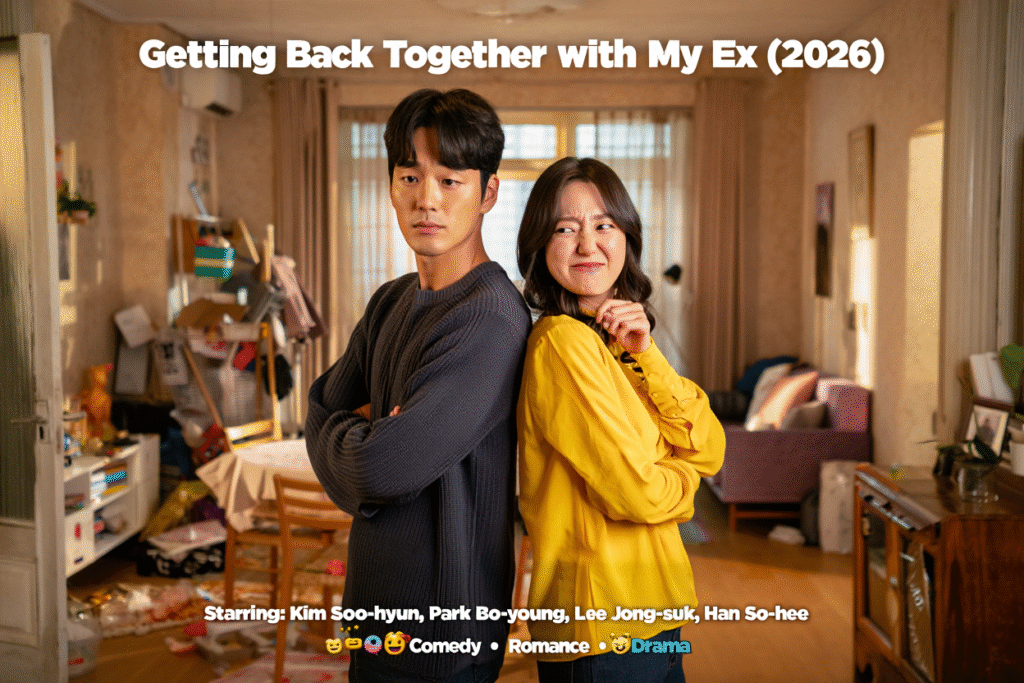
Getting Back Together with My Ex is a charming Korean romantic comedy that leans into one of love’s most universal questions: if two people loved each other once, is that ever really over? Balancing humor, emotional honesty, and bittersweet nostalgia, the film turns an awkward reunion into a heartfelt exploration of timing, growth, and emotional maturity.

Kim Soo-hyun delivers a quietly compelling performance as Joon-ho, a man who appears to have everything figured out—career, stability, composure—except his heart. His emotional restraint is familiar territory for Kim, but here it feels layered with regret rather than distance. Joon-ho isn’t cold; he’s cautious, someone who learned the hard way that love can hurt when left unattended.
Park Bo-young shines as Hae-young, bringing her signature warmth, expressive charm, and comedic timing to a character who feels wonderfully alive. Hae-young is messy, honest, and emotionally transparent—everything Joon-ho isn’t. Park Bo-young gives her depth beyond the bubbly exterior, revealing a woman who once loved deeply and still carries the bruises of that loss.

The forced cohabitation setup is classic rom-com territory, but the film refreshes it with sharp writing and emotionally grounded situations. From arguing over refrigerator space to accidentally reliving old routines, the shared apartment becomes a character in itself—a space filled with unspoken memories, half-healed wounds, and lingering affection. The comedy lands naturally, often rooted in emotional discomfort rather than exaggerated antics.
Lee Jong-suk plays the meddling friend with effortless charisma, injecting levity while subtly pushing both leads toward self-reflection. His character serves as both comic relief and emotional instigator, asking the questions Joon-ho avoids and saying the truths Hae-young doesn’t want to hear. Meanwhile, Han So-hee adds an intriguing emotional contrast, complicating the dynamic without turning the story into a cliché rivalry.
What sets this film apart is its refusal to romanticize the past blindly. The story doesn’t suggest that love alone fixes everything. Instead, it forces the couple to confront why they divorced in the first place—miscommunication, emotional neglect, and differing expectations. These moments are handled with surprising maturity, giving the film emotional weight beneath its lighthearted surface.

Visually, the film favors warmth and intimacy. Soft lighting, cozy interiors, and gentle framing emphasize closeness, while moments of emotional distance are reflected through wider shots and quiet pauses. The cinematography mirrors the push-and-pull of reconnection—drawing the characters together, then pulling them apart just enough to hurt.
The soundtrack complements the story beautifully, blending upbeat acoustic tracks with tender ballads that underscore emotional turning points. Music often fades in during moments of realization rather than confession, reinforcing the idea that love isn’t always announced—it’s felt.
At its core, Getting Back Together with My Ex is about growth. Both Joon-ho and Hae-young are different people than they were before, and the film asks whether love can survive change—or perhaps, because of it. Their second chance isn’t framed as destiny, but as a conscious choice, one that requires honesty, vulnerability, and courage.
By the end, the film leaves you smiling—not because everything is perfect, but because it feels earned. Getting Back Together with My Ex is a warm, relatable, and emotionally satisfying romantic comedy that understands love doesn’t always need a dramatic beginning—sometimes, it just needs a braver second try.