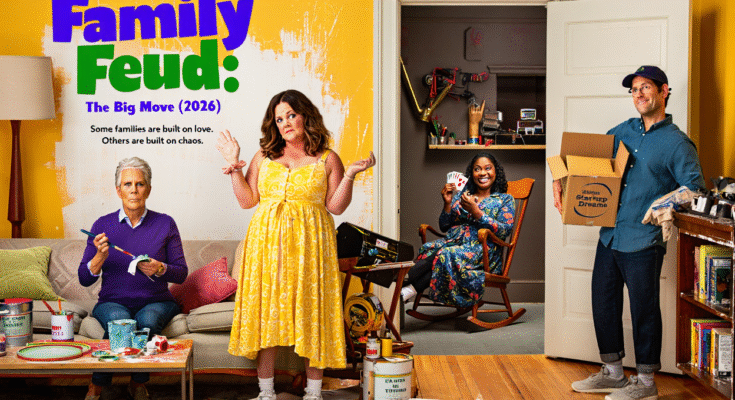
Family Feud: The Big Move thrives on a familiar premise—forced cohabitation—but elevates it through sharp performances, emotional honesty, and a clear understanding that family comedy works best when it hurts just a little. What begins as a slapstick setup gradually reveals itself as a warm, character-driven story about adulthood, responsibility, and the homes we never truly leave behind.
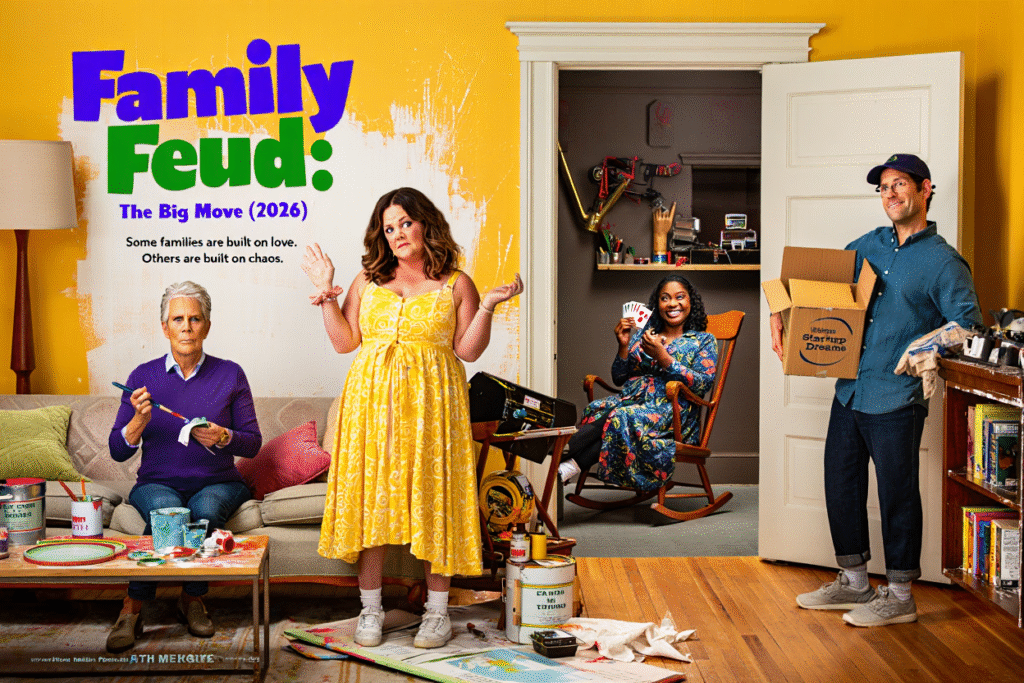
Melissa McCarthy anchors the film as Ellen, delivering a performance that balances comedic exhaustion with emotional grounding. This is McCarthy in one of her strongest modes: funny without excess, reactive rather than performative. Ellen’s struggle to remain “the responsible one” while her life unravels feels painfully relatable, and McCarthy mines real humor from quiet frustration as much as from physical comedy.
Jamie Lee Curtis is pure controlled chaos as Carol, the free-spirited mother who mistakes disruption for reinvention. Curtis leans into Carol’s impulsiveness while subtly revealing a woman terrified of irrelevance. Her redecorating sprees and boundary violations are hilarious, but the film smartly reframes them as a refusal to feel invisible in the later stages of life.
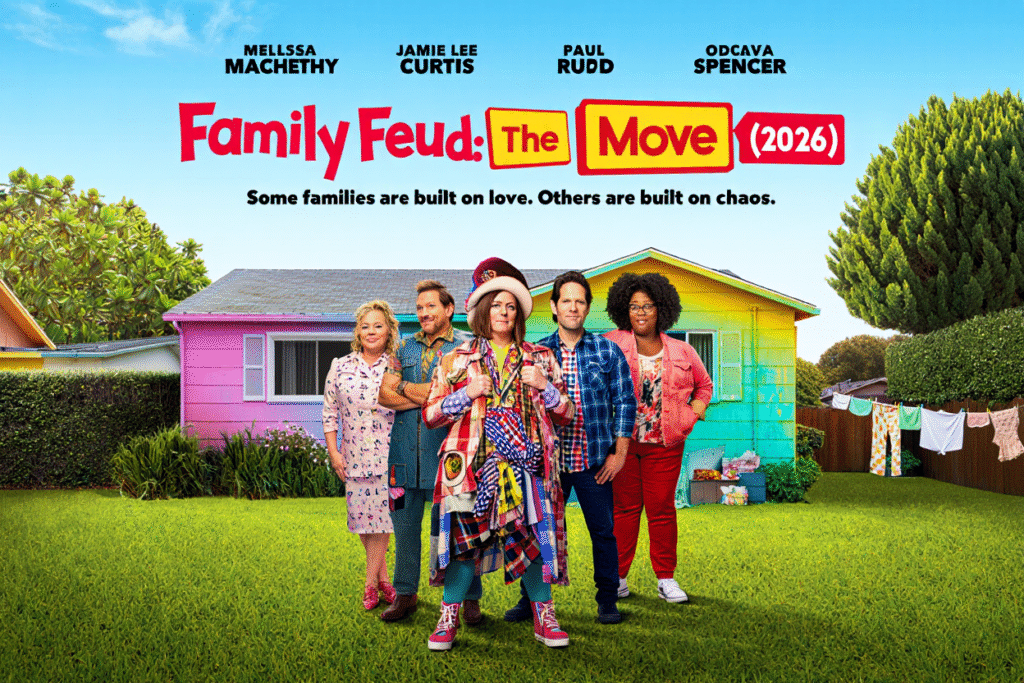
Paul Rudd’s Andy is the film’s wildcard. Equal parts charming and infuriating, Andy’s endless “next big idea” jokes never overstay their welcome thanks to Rudd’s natural likability. The script resists turning him into a caricature, allowing moments where Andy’s arrested development is exposed as fear rather than laziness.
Octavia Spencer quietly steals the movie as Grandma Mildred. Her performance is restrained, precise, and devastatingly funny. Mildred’s blunt commentary and strategic meddling provide the film’s sharpest lines, but Spencer also gives the character a sense of earned wisdom—someone who understands that family dysfunction doesn’t disappear, it just changes shape.
The film’s strongest asset is its ensemble chemistry. Scenes set around the dinner table, in the cluttered living room, or during Mildred’s “family games” crackle with overlapping dialogue and lived-in tension. The humor doesn’t rely on punchlines alone; it grows organically from history, resentment, and affection colliding at full volume.
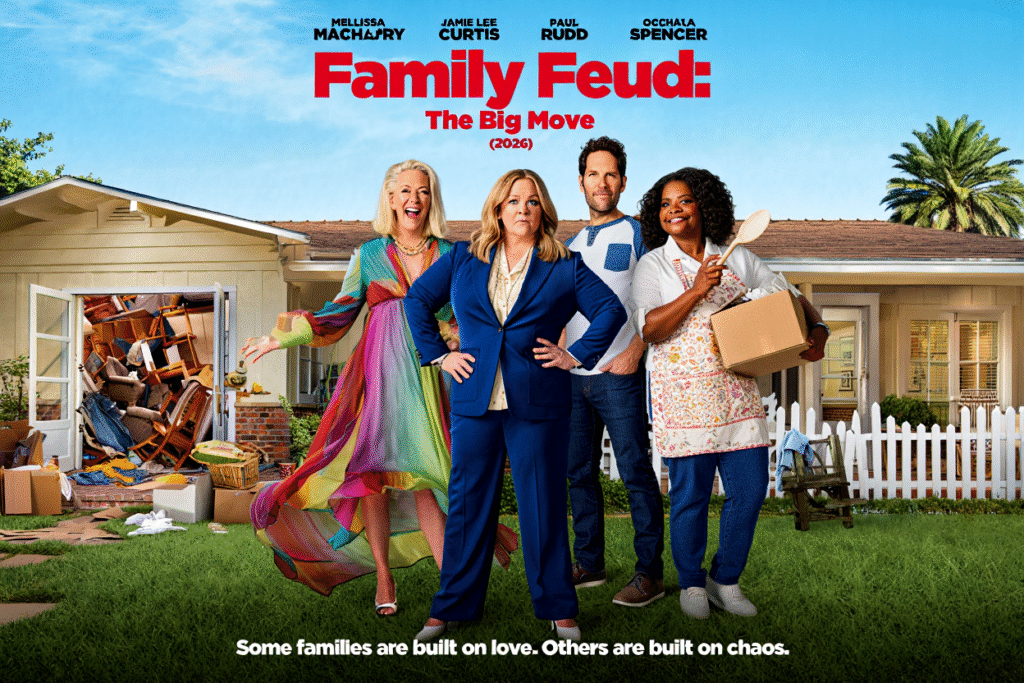
Tonally, The Big Move walks a careful line between comedy and drama. While the basement business failures and surprise renovations deliver laughs, the film isn’t afraid to pause for emotional beats—particularly when Ellen questions whether success actually brought her happiness, or merely distance from the people who know her best.
The fiancé subplot serves as a clever outsider lens, highlighting how normalized chaos becomes when it’s your own. His gradual descent from polite observer to reluctant participant adds both humor and insight, reinforcing the film’s central idea: loving this family requires surrendering control.
Visually, the film keeps things grounded. The childhood home feels cramped, overstuffed, and alive with memory—an intentional contrast to Ellen’s former polished life. The mess is thematic, reinforcing that growth rarely happens in neat spaces.
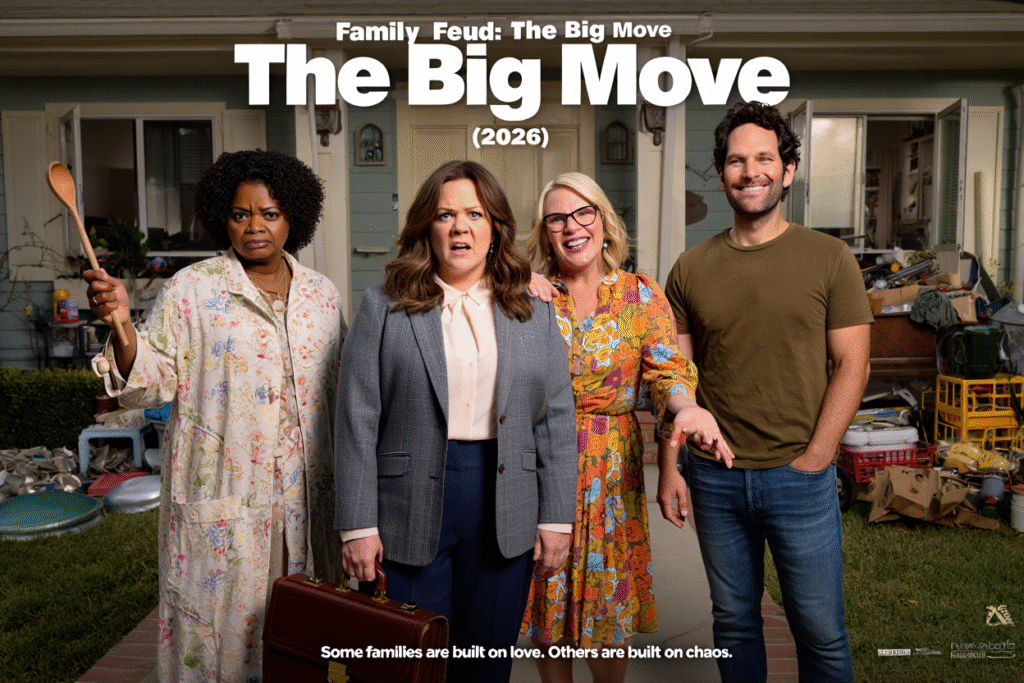
Ultimately, Family Feud: The Big Move succeeds because it understands that family comedies work best when love isn’t idealized. This is a film about noise, mistakes, crossed boundaries, and stubborn loyalty. It reminds us that while chaos may not be chosen, it’s often where belonging lives—and sometimes, moving backward is the only way forward.