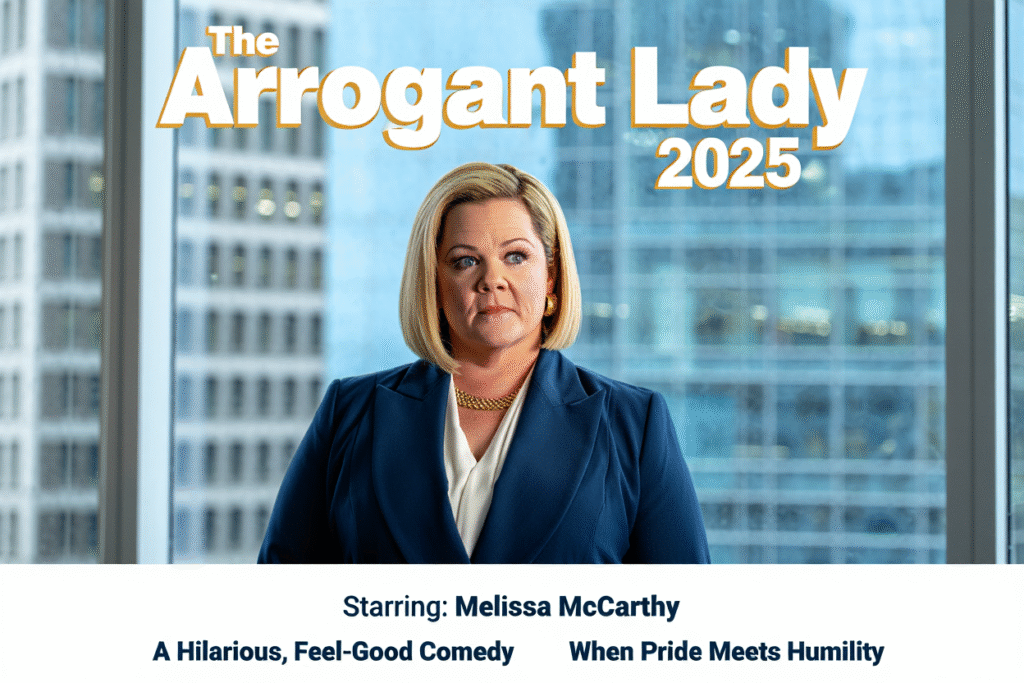
The Arrogant Lady (2025) is a sharp, crowd-pleasing comedy that disguises a surprisingly sincere character study beneath its laugh-out-loud surface. At first glance, it promises pure Melissa McCarthy chaos—and it delivers—but beneath the pratfalls and punchlines lies a story about ego, isolation, and the uncomfortable silence that follows unchecked success.
Melissa McCarthy’s Margaret Thompson is introduced as a woman who has conquered every room she’s ever entered. She speaks louder than everyone else, moves faster than consequences, and treats empathy like a corporate expense she’s already cut. McCarthy plays her not as a villain, but as someone dangerously convinced she’s always right—a choice that makes Margaret both hilarious and painfully recognizable.
The film wastes no time dismantling Margaret’s carefully constructed empire. A simple corporate mix-up—one she initially considers beneath her attention—forces her into a team-building retreat with employees she barely knows and clearly doesn’t respect. What follows is not just a clash of personalities, but a collision between power and humanity.
Much of the comedy comes from watching Margaret lose control. Ice-breaker games become battlegrounds. Team challenges expose her inability to listen. Silence becomes her greatest enemy. McCarthy’s physical comedy is in top form, but it’s her timing—those tiny pauses when confidence cracks—that elevates the humor into something sharper.
What’s refreshing is that the film never rushes Margaret’s transformation. Change doesn’t arrive as a lightning bolt of humility. It creeps in slowly, through discomfort, embarrassment, and moments where Margaret realizes that the people she dismissed actually see her more clearly than she sees herself.
The supporting cast, though intentionally understated, plays a crucial role. These “ordinary” employees aren’t caricatures or moral mouthpieces. They’re grounded, observant, and quietly confident—everything Margaret pretends not to need. Their collective presence becomes a mirror she can no longer avoid.
Emotionally, the film finds its footing in small moments rather than grand speeches. A failed leadership exercise. A conversation overheard but not meant for her. A rare moment where Margaret isn’t the smartest person in the room—and doesn’t know how to sit with that truth.
Romance, when it enters the story, is handled with restraint. It’s not about sweeping gestures, but about vulnerability—something Margaret has avoided her entire life. The idea that connection requires surrender is one of the film’s most honest insights.
Visually, The Arrogant Lady keeps things simple, allowing performances to take center stage. The retreat setting becomes a symbolic neutral ground—no corner office, no power suit, no escape. Everyone is equal here, and Margaret feels that imbalance deeply.
By the final act, the film resists the temptation of a perfect redemption. Margaret doesn’t become a saint, and the film is better for it. Growth here means awareness, not perfection. It means choosing to listen when instinct says to dominate.
The Arrogant Lady (2025) succeeds because it understands its star. Melissa McCarthy isn’t just playing for laughs—she’s playing for truth wrapped in comedy. The result is a feel-good film that entertains, disarms, and gently reminds us that success without connection is just another form of loneliness.