Scary Stories to Tell Tonight (2026) embraces the oldest horror tradition of all—telling ghost stories in the dark—and gleefully asks what would happen if those stories decided to talk back. Blending meta-horror with broad comedy, the film positions itself somewhere between Creepshow, Goosebumps, and a late-night improv session gone terribly wrong. The result is a crowd-pleasing, self-aware horror-comedy that knows exactly when to scare you and when to let you laugh.
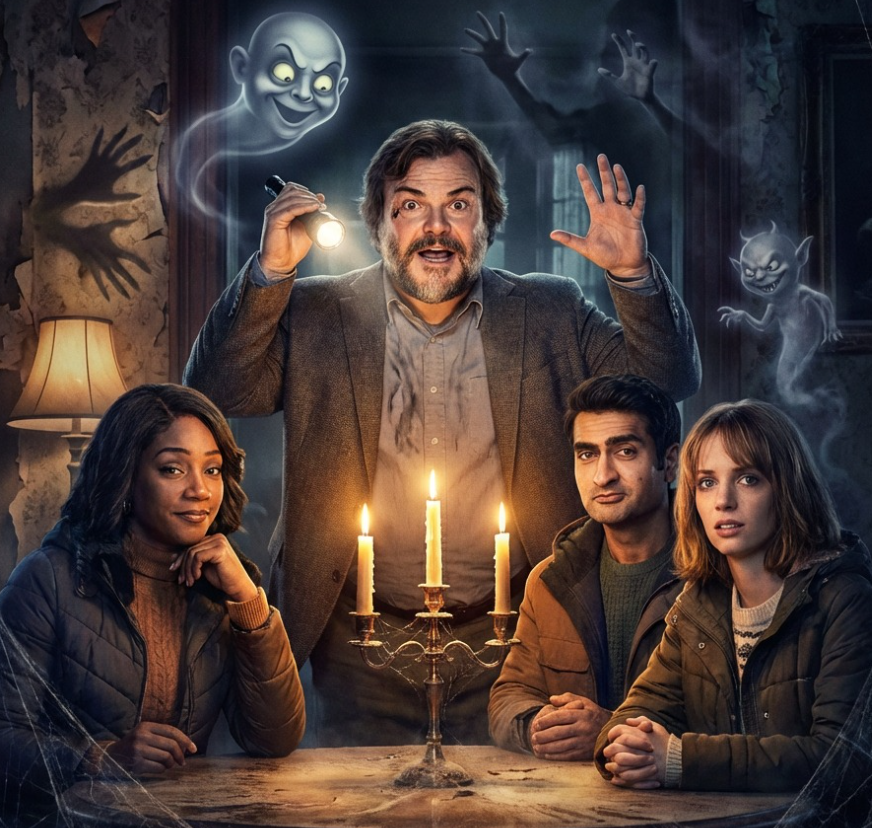
Jack Black is the film’s chaotic engine, playing an unapologetic horror nerd who treats storytelling like a full-contact sport. His performance is big, loud, and intentionally unhinged, but never careless. Black understands the rhythm of horror-comedy better than almost anyone, and he weaponizes that instinct here—using enthusiasm as both comic relief and narrative catalyst. When things start going wrong, it’s his character’s unchecked joy that makes the danger feel earned.
Tiffany Haddish provides the perfect counterbalance. Her skeptic role could have been one-note, but Haddish grounds it with sharp timing and emotional clarity. She doesn’t just dismiss the supernatural—she challenges it, interrogates it, and eventually fears it in a way that feels authentic. Watching her transition from disbelief to reluctant leadership is one of the film’s most satisfying arcs.
Kumail Nanjiani plays anxiety not as a punchline, but as a survival tool. His character’s constant overthinking becomes unexpectedly useful once the stories manifest into physical threats. Nanjiani’s dry delivery and escalating panic add a human layer to the chaos, making the audience root for him even as he’s clearly outmatched. He’s the kind of character horror fans recognize instantly—the one who knows how doomed they all might be.
Maya Hawke quietly steals scenes as the intuitive observer, the one who listens more than she speaks. Her performance leans into restraint, allowing tension to build through glances and pauses rather than dialogue. Hawke’s character acts as the film’s emotional compass, piecing together the haunted house’s mythology with a calm that contrasts beautifully with the escalating madness around her.
Structurally, the film thrives on its anthology-style scares. Each story manifests as a distinct horror vignette—ranging from grotesque creature features to eerie psychological hauntings—giving the film visual variety and tonal flexibility. Some segments lean more comedic, others genuinely unsettling, but all feel connected by a cohesive internal logic that rewards attentive viewers.
Visually, Scary Stories to Tell Tonight embraces practical effects wherever possible. The monsters feel tactile, messy, and uncomfortably close, evoking old-school horror charm rather than sleek CGI polish. The haunted house itself becomes a character—its creaking floors, shifting hallways, and shadowed corners reinforcing the idea that stories leave stains behind.
The screenplay is smartest when it reflects on why people tell scary stories in the first place. Fear becomes a form of bonding, a way to test courage, and a method of controlling the uncontrollable. The film subtly suggests that stories don’t just entertain—they shape how we confront the unknown, whether we’re prepared or not.
Tonally, the movie never takes itself too seriously, but it also never mocks the genre. The scares are real, the stakes escalate convincingly, and when characters are threatened, the film allows moments of genuine tension to breathe. That balance keeps the comedy from undercutting the horror—and vice versa.
⭐ Final Verdict: Scary Stories to Tell Tonight is a smart, energetic horror-comedy that understands the power of storytelling and the fun of fear. With a charismatic ensemble cast, inventive scares, and a playful respect for horror tradition, it’s the kind of movie best watched at night with friends—lights low, laughter ready, and maybe a few stories left untold. 🎃👻